



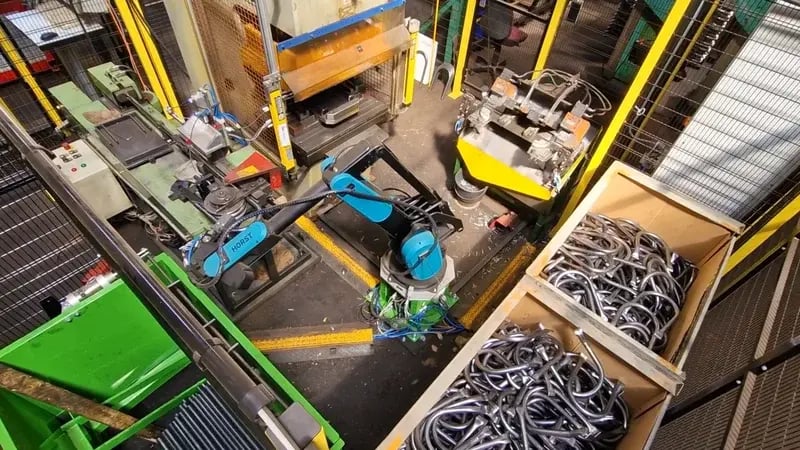
 Benjamin Brumm

Medical technology embodies innovation, precision and safety. Thequality requirements for metal productssuch as surgical instruments, implants and medical devices in particular are extremely high. Errors or inaccuracies can have serious consequences, which is why regulatory requirements such as ISO 13485 or the European Medical Device Regulation (MDR) set strict standards. Find out more about the challenges in quality assurance and solutions through automation in this article.
Introduction
Metal processing plays a central role in the manufacture of medical technology products. Tight tolerances, complex geometries and documentation requirements for traceability demand consistently reliable quality assurance. Manufacturers must therefore be very familiar with the properties of the alloys used. But that is not the only thing that is important to remain successful. The medtech industry is also under increasing pressure to reduce costs and produce efficiently - especially due to aggressive competition from low-wage countries.
Automation with industrial robots offers solutions that improve both efficiency and reliability .
Challenges in quality assurance
Technical challenges
The metalworking industry is confronted with the following technical requirements in medical technology:
- Maximum precision: products such as surgical instruments or implants require accuracies in the micrometer range.
- Complex geometries: Many components have a delicate structure and are therefore difficult to handle, which in turn also makes them more difficult to inspect.
- Variety of materials: Different metal alloys such as stainless steel, titanium, cobalt-chrome or tantalum require adapted testing methods.
Regulatory requirements
Regulatory requirements go beyond flawless product quality and demand equally comprehensive documentation:
- Traceability: every production and control step must be documented.
- Validation processes: All test procedures must be validated and regularly checked. 1
Challenges with manual processes
Manual processes are still widely used in quality assurance in the metalworking industry, but they have considerable disadvantages:
- Human error: even experienced inspectors cannot completely rule out inaccuracies.
- Time-consuming: Manual inspection processes are time-consuming and therefore expensive.
Solutions through automation
Automated testing and quality assurance
The use of industrial robots in quality assurance offers many advantages:
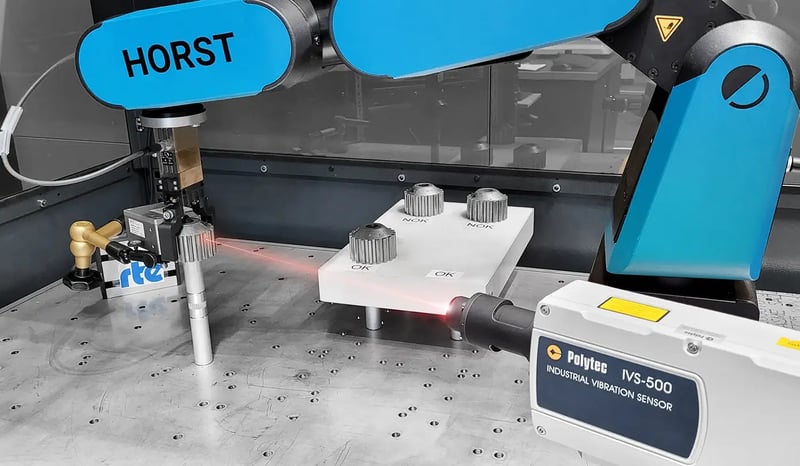
- Precision: robots can be equipped with sensors and camera systems to detect even the smallest deviations.
- Consistency: Automated processes guarantee reproducible results without fluctuations.
- Data integration: Results can be transferred directly to digital systems and documented if required.
Machine assembly
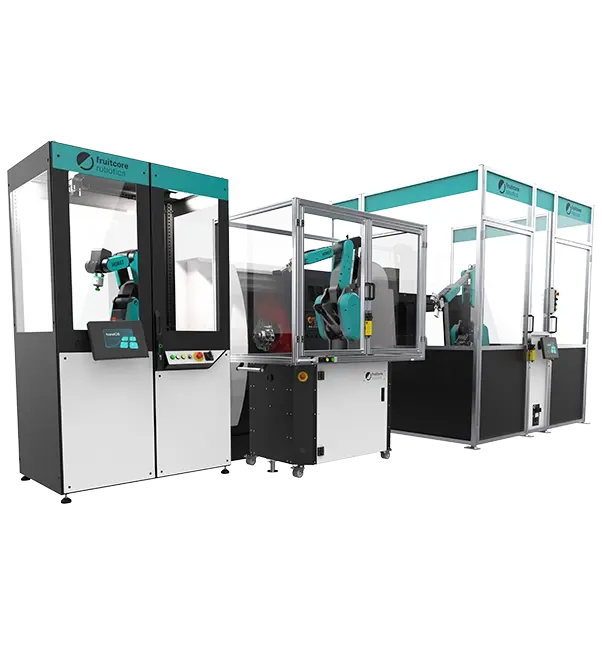
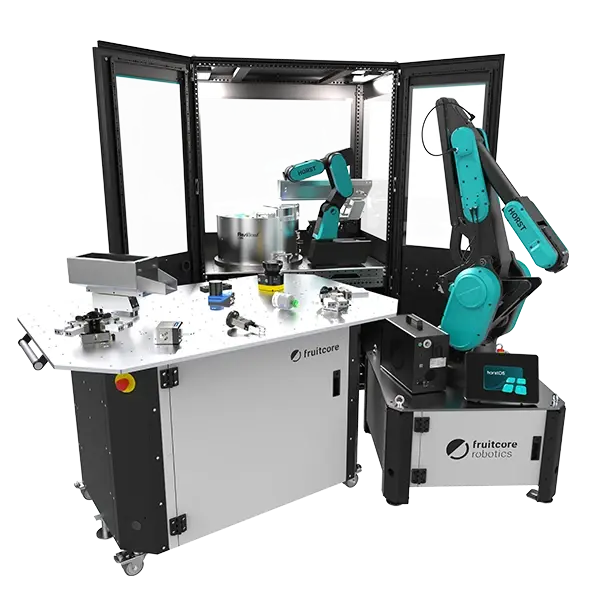
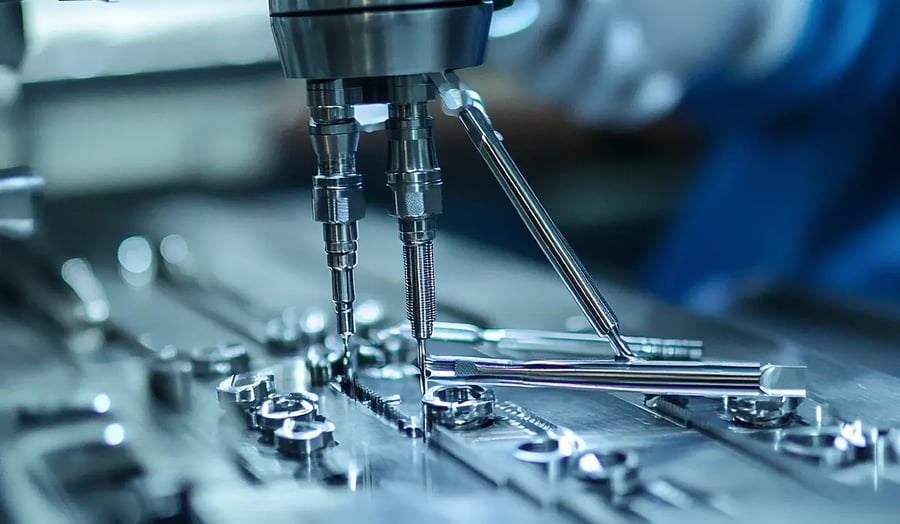
A key area of application for industrial robots is the loading and unloading of machines. For quality assurance tasks, this specifically means that robots automatically load testing machines and thus enable more efficient processes:
- Manual intervention is reduced: Operating personnel can concentrate on higher-level tasks with greater added value. In the event of staff shortages, which are now the rule rather than the exception, manufacturers can close this gap easily and cost-effectively through automation.
- Flexibility: Modern robot systems can be adapted to different components and inspection methods. In addition, they are now so user-friendly to set up and operate that anyone can work with robots without extensive training.
Competitive advantages through special technologies
Modern, intelligent industrial robots minimize human error and guarantee consistently high quality, as well as offering advantages that set them apart from conventional robots :
- Simple operation: generally understandable user interfaces and intuitive programming methods such as graphical interfaces, step-by-step wizards or drag-and-drop functions make it possible for employees without extensive robotics knowledge to operate the systems. This means that no experts or time-consuming and cost-intensive training by the robot manufacturer is required and the automation can be used much faster than generally assumed .
- Low maintenance costs: The modular design and the use of durable materials and AI-supported diagnostic tools minimize maintenance costs. The robot systems detect many potential problems at an early stage and can plan maintenance cycles efficiently, which increases service life and reduces operating costs.
- Real-time support: Thanks to modern networking, robot data can be transmitted in real time, enabling remote diagnostics and updates. These real-time functions speed up troubleshooting and drastically reduce downtime.
Increased efficiency through automation
The automation of testing and production processes leads to considerable increases in efficiency:
- Throughput times are shortened: products can be delivered more quickly thanks to faster handling and testing.
- Scalability: Automated solutions can be adapted to different production requirements and enable a rapid response to changes in the market or in regulations .
 Conclusion
Quality assurance in the metal processing of medical technology products is a challenging task that can be reliably mastered through automation. Companies that rely on automated solutions secure their competitiveness and at the same time meet the high requirements of medical technology. The integration of such technologies is a decisive step towards meeting the increasing demands of the market.
Sources
1) https://www.bfarm.de/EN/Medical-devices/_FAQ/Classification-differentiation/faq-liste.html